

The number 15 in the Bible carries a quiet but powerful message of grace, deliverance, and holy rest. Across Scripture, it appears near feast days, healing stories, covenant moments, and seasons when God turns pressure into peace. From Hezekiah’s added fifteen years to the fifteenth day connected with biblical festivals, this number points readers toward mercy after struggle.
It doesn’t work like a secret code, and it shouldn’t be treated as superstition. Instead, the biblical meaning of 15 grows from context, pattern, and faith-filled study. In this guide, you’ll explore its meaning, symbolism, and 50+ references with explanations for everyday Bible readers who want clarity without confusion, hype, or guesswork.
What Does the Number 15 Mean in the Bible?
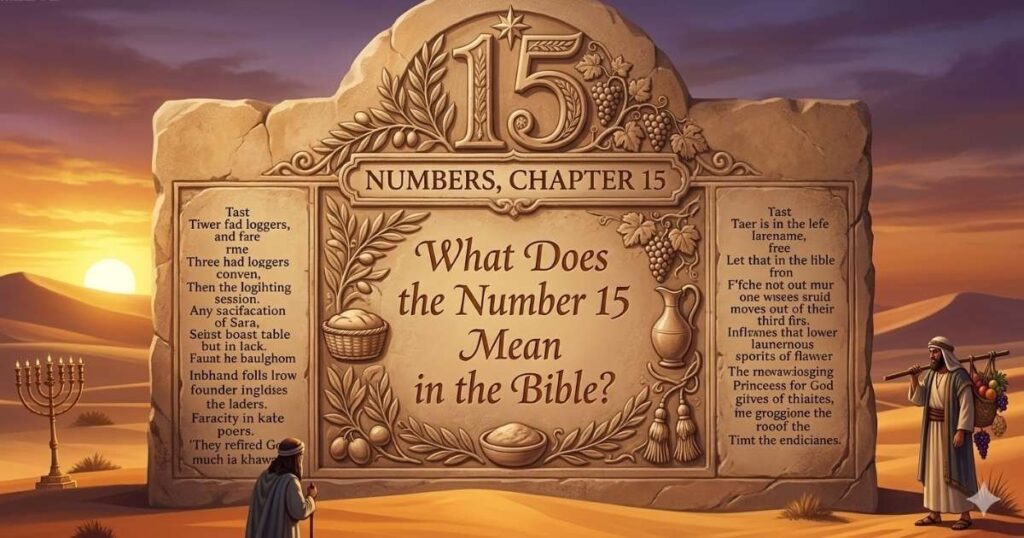
The number 15 in the Bible often connects with rest, redemption, and biblical deliverance after trouble. The pattern becomes clear when you compare major passages. The fifteenth day starts major feasts, Hezekiah receives fifteen added years, and Noah’s flood 15 cubits covers the mountains in judgment. (BibleGateway)
The meaning is not magical. The Bible doesn’t say, “Fifteen always means this.” However, repeated use matters. In several stories, God moves people from danger into safety. That makes number 15 symbolism rich, warm, and deeply human. It feels like sunrise after a storm.
Quick Summary of the Biblical Meaning of 15
The biblical meaning of 15 can be understood as a sign of grace, rescue, renewed hope, and sacred celebration. It often appears after conflict, judgment, or waiting. In that sense, fifteen works like a doorway. Trouble stands on one side. God’s grace shines on the other.
| Theme | How Fifteen Appears | Main Lesson |
| Deliverance | Esther and Purim joy on Adar 15 | God can turn fear into feasting |
| Healing | King Hezekiah 15 years | Prayer matters before God |
| Festivals | Passover season leads into Unleavened Bread on Nisan 15 | Freedom should become worship |
| Rest | Tabernacles begins on Tishri 15 | God gives joy after harvest |
| Redemption | Hosea and Gomer includes fifteen shekels | Love can buy back the broken |
| Judgment | Floodwaters rise fifteen cubits | God judges evil seriously |
Spiritual Symbolism of the Number 15 in Scripture
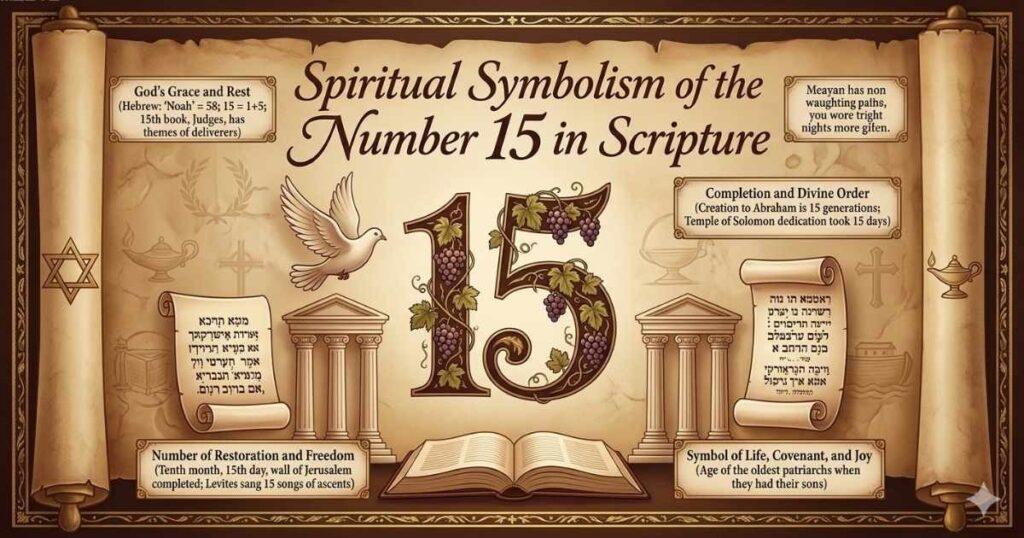
The spiritual meaning of number 15 grows from stories, not guesswork. In Leviticus, the fifteenth day starts the Feast of Unleavened Bread after Passover. That matters. Israel left slavery, then entered a week of clean bread, holy assembly, and remembered freedom. (BibleGateway)
Here is the heart of Bible numerology 15. Fifteen often stands near release, cleansing, and celebration. It whispers, “The chains didn’t win.” That makes the spiritual picture strong. God brings people into rest, not because they earn it, but because His covenant love holds.
Number 15 Symbolism in Simple Words
Number 15 symbolism points to grace after struggle. It appears near rescue from enemies, added life after sickness, and holy feasts after bondage. That doesn’t make fifteen a charm. It makes it a reminder. Scripture keeps showing God meeting people at the right timing.
“I have heard your prayer and seen your tears.” (BibleGateway)
That short line from Hezekiah’s story gives the theme a heartbeat. God does not treat human pain like background noise. He hears, answers, heals, and sometimes gives more years than anyone expected.
The Number 15 in the Old Testament
The Old Testament number 15 appears in Genesis, Exodus, Leviticus, Numbers, Esther, Hosea, and the story of Hezekiah. These passages don’t all say the same thing. Yet many of them circle around survival, rescue, holy calendars, covenant love, and renewed worship.
In Genesis, Noah’s flood 15 cubits shows judgment that fully covered the mountains. In Hosea, the prophet buys back Gomer for fifteen shekels and barley, creating a living picture of wounded love and redemption. In Esther, the fifteenth of Adar becomes a day of gladness and rest. (BibleGateway)
Old Testament Number 15 Reference Table
| Passage | Fifteen Connection | Deeper Meaning |
| Genesis 7:20 | Floodwaters rise fifteen cubits | Judgment covers human pride |
| Leviticus 23:6 | Nisan 15 begins Unleavened Bread | Freedom needs holy memory |
| Leviticus 23:34 | Tishri 15 begins Tabernacles | Harvest joy becomes worship |
| Esther 9:18–21 | Adar 15 becomes a feast day | Deliverance turns into joy |
| Hosea 3:2 | Hosea and Gomer includes fifteen shekels | Redemption has a cost |
| 2 Kings 20:6 | King Hezekiah 15 years | Prayer, healing, and mercy meet |
The Number 15 and Biblical Festivals
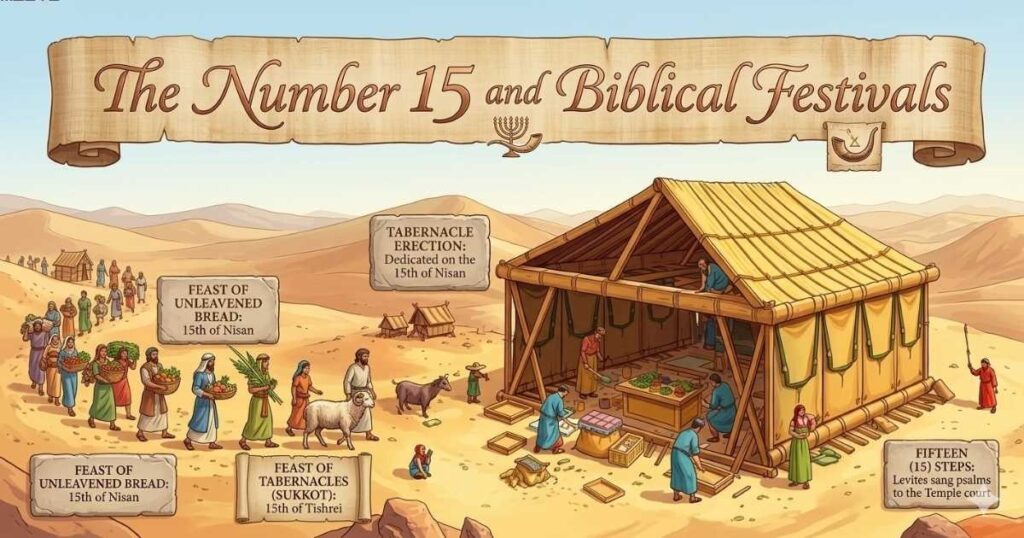
The number 15 in the Bible shines brightly in Bible festivals. The Feast of Unleavened Bread begins on the fifteenth day of the first month, right after Passover. This timing matters. Israel didn’t celebrate freedom vaguely. They marked it on the calendar with bread, memory, and obedience. (BibleGateway)
The Feast of Tabernacles also begins on the fifteenth day of the seventh month. Leviticus connects it with harvest joy, branches, sacred assembly, and rest. That makes fifteen feel like a full table after a lean season. God doesn’t only rescue. He teaches His people to rejoice. (BibleGateway)
Fifteenth Day Festival Pattern
| Festival | Month | Date | Main Theme |
| Feast of Unleavened Bread | Nisan | 15th day | Freedom after Passover |
| Feast of Tabernacles | Tishri | 15th day | Harvest joy and rest |
| Purim celebration in Susa | Adar | 15th day | Deliverance from enemies |
The 15th Day in the Bible and Its Importance
The 15th day in Scripture carries strong covenant meaning. In Israel’s calendar, the fifteenth day often lands after a turning point. Passover happens on the fourteenth of Nisan, then Unleavened Bread begins on the fifteenth. Rescue comes first. Holy living follows right behind it. (BibleGateway)
The same pattern appears in Tishri. After harvest, Israel begins Tabernacles on the fifteenth day. Families remember wilderness shelter, daily dependence, and divine care. So the fifteenth day becomes more than a date. It becomes a classroom where God teaches memory, gratitude, and faith.
Why the Fifteenth Day Matters
The fifteenth day matters because it often marks the move from crisis into celebration. In plain English, it is the “now breathe” moment. God brings His people through danger, then calls them to stop, gather, eat, remember, and worship with honest joy.
Famous Bible Events Connected to the Number 15
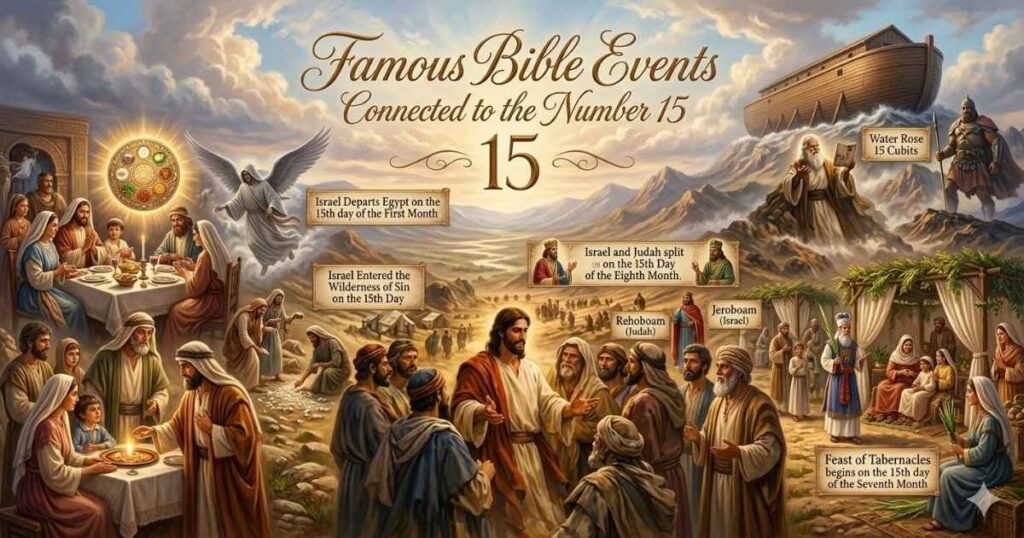
The most famous story is King Hezekiah 15 years. Hezekiah became deathly sick, turned his face to the wall, and prayed. God answered through Isaiah, promised healing, and added fifteen years to his life. This story shows prayer can change a room filled with dread. (BibleGateway)
Another famous case is Hosea and Gomer. Hosea buys Gomer for fifteen shekels and barley, then calls her into faithfulness. It is gritty, tender, and almost embarrassing in its mercy. That’s the point. Redemption is not tidy. It often walks into messy places with open hands. (BibleGateway)
Case Study: Hezekiah’s Fifteen Added Years
Hezekiah’s story gives the spiritual meaning of number 15 a personal face. He didn’t receive vague comfort. He received time, healing, and deliverance from Assyria. His tears became part of the answer, not proof of weak faith.
Case Study: Hosea, Gomer, and Costly Redemption
Hosea’s purchase of Gomer shows love with a price tag. The fifteen shekels and barley point beyond arithmetic. They create a picture of God’s grace toward unfaithful people. In that story, covenant love does not shrug at sin. It pays, restores, and calls for change.
The Number 15 in the New Testament
The New Testament number 15 appears less often than in the Old Testament, but it still matters. Luke opens John the Baptist ministry in the fifteenth year of Tiberius Caesar. That detail anchors John Baptist in real history, not fairy-tale fog. (BibleGateway)
In Acts, Paul survives a terrifying sea journey. Sailors measure twenty fathoms, then fifteen fathoms, as the ship nears danger. The passage does not turn fifteen into a symbol by itself. Still, it places fifteen inside a story where God preserves life during chaos. (BibleGateway)
New Testament Number 15 Reference Table
| Passage | Fifteen Connection | Why It Matters |
| Luke 3:1–3 | Fifteenth year of Tiberius | John the Baptist ministry begins in history |
| Acts 27:28 | Sailors measure fifteen fathoms | Paul moves through danger under divine care |
| Galatians 1:18 | Paul stays with Peter fifteen days | Early apostolic contact matters |
Prophetic Meaning of the Number 15 in the Bible
The prophecy angle needs care. The Bible does not say every fifteen is a hidden prediction. Still, the number can sit near prophetic moments. Hosea acts out redemption. Hezekiah receives a prophetic word from Isaiah. John Baptist begins preaching repentance at a marked historical time.
The prophetic meaning of fifteen often points toward restoration after warning. First comes truth. Then comes mercy. That rhythm runs through Scripture like a river under the ground. God exposes sin, calls people back, and offers hope through grace, covenant, and repentance.
Prophetic Meaning Without Guesswork
The safest way to read Bible numerology 15 is to let each passage lead. Fifteen can support themes of deliverance, healing, rest, and restored worship. Yet context always drives interpretation. A number should serve Scripture. It should never boss it around.
50+ Bible References Related to the Number 15
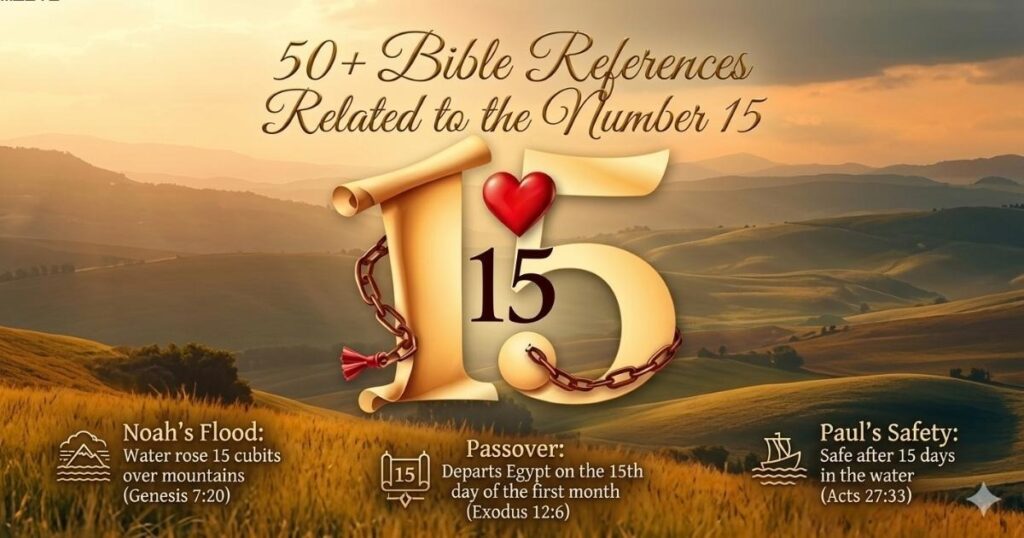
The number 15 in the Bible appears through direct numbers, fifteenth-day dates, fifteen-year periods, and related scenes. Some references carry major theological weight. Others simply give measurements or dates. Together, they show that fifteen belongs to a wider biblical pattern of judgment, mercy, celebration, and timing.
This table gives more than fifty references and study angles. Read them slowly. You’ll see how God, grace, deliverance, rest, festivals, worship, prayer, healing, redemption, blessings, faith, and hope keep returning like familiar music.
| # | Reference | Connection to Fifteen | Study Note |
| 1 | Genesis 7:20 | Fifteen cubits above the mountains | Judgment reaches its full height |
| 2 | Genesis 7:21 | Flood judgment continues | Human violence meets holy justice |
| 3 | Genesis 7:22 | Breath of life ends on dry land | Life belongs to God |
| 4 | Genesis 7:23 | Noah remains with the ark | Rescue stands inside judgment |
| 5 | Exodus 12:6 | Passover lamb before Nisan 15 | Freedom has preparation |
| 6 | Exodus 12:14 | Memorial feast command | Worship remembers rescue |
| 7 | Exodus 12:15 | Seven days of unleavened bread | Cleansing follows freedom |
| 8 | Exodus 12:17 | Israel keeps the feast | Deliverance becomes tradition |
| 9 | Exodus 12:18 | Unleavened bread begins on fifteenth evening | Nisan timing matters |
| 10 | Exodus 13:3 | Remember coming out of Egypt | Memory protects faith |
| 11 | Leviticus 23:5 | Passover before the fifteenth | Rescue comes before feast |
| 12 | Leviticus 23:6 | Fifteenth day begins Unleavened Bread | Holy eating teaches freedom |
| 13 | Leviticus 23:7 | Sacred assembly follows | Rest becomes obedience |
| 14 | Leviticus 23:8 | Seven days of offerings | Freedom leads to worship |
| 15 | Leviticus 23:34 | Tabernacles begins on Tishri 15 | Joy follows harvest |
| 16 | Leviticus 23:35 | First day is sacred assembly | Work stops for God |
| 17 | Leviticus 23:36 | Seven days of offerings | Celebration stays holy |
| 18 | Leviticus 23:39 | Fifteenth day after harvest | Rest frames rejoicing |
| 19 | Leviticus 23:40 | Branches and rejoicing | Creation joins celebration |
| 20 | Leviticus 23:41 | Annual feast command | Covenant memory repeats |
| 21 | Leviticus 23:42 | Israel lives in booths | Humility guards blessings |
| 22 | Leviticus 23:43 | Future generations remember | Children learn God’s grace |
| 23 | Numbers 28:16 | Passover named on fourteenth | Fifteenth follows rescue |
| 24 | Numbers 28:17 | Fifteenth day feast begins | Holy calendar repeats freedom |
| 25 | Numbers 28:18 | Sacred assembly and no work | Rest is built into worship |
| 26 | Numbers 28:19 | Offerings begin | Worship costs something |
| 27 | Numbers 28:20 | Grain offering details | Gratitude becomes measured |
| 28 | Numbers 28:21 | Repeated offerings | Obedience has rhythm |
| 29 | Numbers 28:22 | Sin offering included | Joy needs cleansing |
| 30 | Numbers 28:23 | Morning offering remains | Daily worship continues |
| 31 | Numbers 28:24 | Seven-day offering pattern | Freedom receives structure |
| 32 | Numbers 29:12 | Tishri 15 begins feast | Harvest turns into praise |
| 33 | Numbers 29:13 | Offerings for Tabernacles | Abundance returns to God |
| 34 | Numbers 29:14 | Grain offerings | Details matter in worship |
| 35 | Numbers 29:15 | More offerings listed | Holiness shapes celebration |
| 36 | Numbers 29:16 | Sin offering included | Joy stays humble |
| 37 | 2 Kings 20:5 | Hezekiah receives answer | Prayer reaches heaven |
| 38 | 2 Kings 20:6 | Fifteen years added | Healing and mercy meet |
| 39 | 2 Kings 20:7 | Fig poultice applied | God can use simple means |
| 40 | 2 Kings 20:8 | Sign requested | Weak hearts need assurance |
| 41 | 2 Kings 20:9 | Sign offered | God meets fear gently |
| 42 | Isaiah 38:5 | Fifteen years promised again | Prophecy comforts the king |
| 43 | Isaiah 38:6 | City delivered from Assyria | Personal mercy meets national rescue |
| 44 | Isaiah 38:7 | Sign from the Lord | Hope receives evidence |
| 45 | Isaiah 38:8 | Shadow moves backward | Time bends under God |
| 46 | Esther 9:17 | Jews rest after battle | Deliverance leads to feasting |
| 47 | Esther 9:18 | Susa rests on fifteenth day | Fear turns into joy |
| 48 | Esther 9:19 | Rural Jews feast | Gladness spreads through community |
| 49 | Esther 9:21 | Fourteenth and fifteenth of Adar | Rescue gets remembered yearly |
| 50 | Esther 9:22 | Sorrow turns into gladness | God’s grace reverses disaster |
| 51 | Hosea 3:2 | Fifteen shekels and barley | Redemption has a cost |
| 52 | Hosea 3:3 | Gomer called to faithfulness | Mercy also calls for holiness |
| 53 | Hosea 3:4 | Israel waits many days | Restoration may take time |
| 54 | Hosea 3:5 | Israel seeks the Lord | Future hope remains alive |
| 55 | Luke 3:1 | Fifteenth year of Tiberius | History marks ministry |
| 56 | Luke 3:2 | Word comes to John | God speaks in the wilderness |
| 57 | Luke 3:3 | John preaches repentance | John Baptist prepares hearts |
| 58 | Acts 27:27 | Storm reaches the fourteenth night | Danger grows near |
| 59 | Acts 27:28 | Fifteen fathoms measured | Crisis approaches land |
| 60 | Acts 27:29 | Sailors pray for daylight | Human fear seeks mercy |
| 61 | Galatians 1:18 | Paul visits Peter fifteen days | Early witness connects |
| 62 | Galatians 1:19 | James also mentioned | Apostolic roots matter |
FAQs
- What does the number 15 represent biblically?
Biblically, 15 is often linked with rest, deliverance, and God’s grace, especially since major feasts began on the 15th day. - What does the number 50 symbolize in the Bible?
The number 50 symbolizes freedom, release, and celebration, mainly through the Year of Jubilee and Pentecost. - Who did God give 15 years to?
God gave King Hezekiah 15 more years of life after he prayed for healing. - Why is 15 a special number?
15 is special because it appears around key biblical moments of deliverance, worship, and renewed life. - What does the number 15 mean in Hebrew?
In Hebrew numbering, 15 is written as ט״ו because the usual letters would form part of God’s sacred name.
Conclusion
The number 15 in the Bible teaches more than trivia. It gathers stories of deliverance, rest, healing, and redemption. It appears when people remember freedom, survive danger, receive added life, or celebrate after fear. That’s why this number feels so full of hope.
Still, wise readers stay grounded. Don’t treat fifteen like a fortune cookie. Read the passage. Ask what God is doing. Notice the context. Then let the pattern encourage you. In Scripture, fifteen often sounds like this: the storm was real, but grace had the final word.
You havr to read “gracebloomdaily”
Meta Description
Explore the Number 15 in the Bible, its meaning, symbolism, and 50+ biblical references tied to grace, rest, and deliverance today
